The History of Tarot: From Playing Cards to Mystical Oracle
Explore the fascinating origins and evolution of tarot cards, from 15th-century Italian card games to their modern role as a powerful tool for divination and self-reflection.
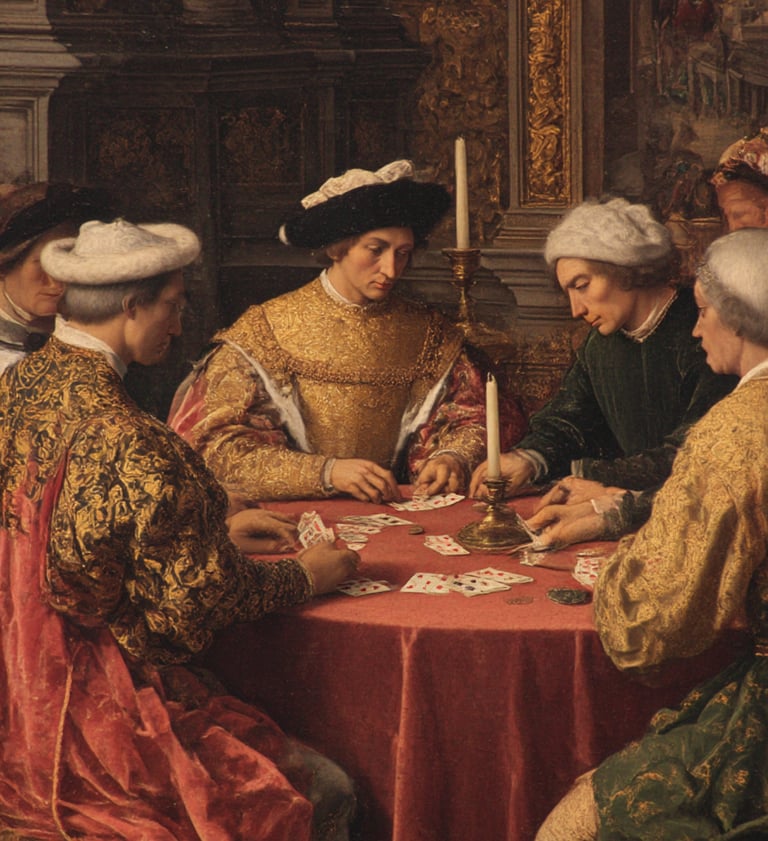
Tarot cards are one of the most fascinating and enduring symbols of mysticism in human history. Shuffled by seekers of truth, laid out by fortune-tellers, and studied by scholars, these 78 illustrated cards have captivated the human imagination for centuries. Yet the story of tarot is far more complex and surprising than most people realize. Long before they became tools of divination and spiritual self-discovery, tarot cards were simply used as a game a pastime for the noble classes of Renaissance Italy. Their journey from a card game to a mystical oracle spans more than six hundred years and crosses the borders of multiple civilizations, philosophical movements, and cultural revolutions. To truly understand tarot, one must trace this remarkable evolution from its earliest origins to its role in the modern world.
Origins: A Game Before a Mystery
a tower struck by lightning, a woman holding the jaws of a lion, a skeleton riding a horse were deeply evocative and open to interpretation. Yet despite this richness, the idea of using tarot cards for fortune-telling or spiritual guidance did not emerge in any serious or widespread way until the late 18th century.
the legendary "Book of Thoth." Although this theory was entirely without historical basis and has been thoroughly debunked by modern historians, it ignited a wildfire of occult fascination with tarot that spread rapidly across Europe.
also a Golden Dawn member and published by the Rider Company, this deck represented a radical departure from all previous tarot designs. For the first time, every single card in the deck including all 56 cards of the Minor Arcana was illustrated with a full scene depicting human figures in meaningful situations. In all previous decks, the Minor Arcana cards had simply shown the number of suit symbols (for example, seven cups arranged in a geometric pattern), with no narrative imagery whatsoever.
The Rider Waite Smith deck changed everything. By giving each card a vivid, story like illustration, Waite and Smith made the tarot dramatically more accessible and interpretable for ordinary people. A reader no longer needed to memorize abstract divinatory meanings; instead, they could look at the image on the card and intuit its message. The Three of Swords showed a heart pierced by three blades against a stormy sky clearly suggesting heartbreak, sorrow, and separation. The Nine of Cups depicted a satisfied figure seated before a display of nine cups suggesting contentment, wishes fulfilled, and emotional abundance.
The symbolism embedded in the Rider Waite Smith deck drew deeply on Kabbalistic, astrological, and Hermetic traditions, creating a rich and coherent symbolic language that could be explored on many levels. The deck proved enormously popular and remains, to this day, the most widely used and influential tarot deck in the world. The vast majority of modern tarot decks are designed in direct reference to the Rider-Waite-Smith tradition, and its imagery has become the standard by which all other decks are judged.
Court de Gebelin's ideas were picked up by occultists and esotericists who saw in the symbolic imagery of the tarot a perfect vehicle for their mystical systems. One of the most important figures of this era was Jean-Baptiste Alliette, who wrote under the pen name "Etteilla." In 1783, Etteilla published the first known book explicitly dedicated to the use of tarot cards for divination, and in 1789 he produced the first tarot deck designed specifically for fortune telling purposes. He assigned detailed divinatory meanings to each card and developed a system of card reading that many consider the foundation of modern tarot practice. Etteilla was also one of the first people to suggest a correspondence between tarot cards and the principles of astrology, numerology, and the four classical elements associations that would become central to Western esoteric tarot traditions.
Throughout the 19th century, French occultists continued to deepen the symbolic and philosophical framework of tarot. Eliphas Levi, one of the most influential occultists of the 19th century, drew powerful connections between the 22 Major Arcana cards and the 22 letters of the Hebrew alphabet, linking tarot to the Jewish mystical tradition of Kabbalah. This synthesis was immensely influential and provided the intellectual foundation for the tarot systems developed by later secret societies, most notably the Hermetic Order of the Golden Dawn.
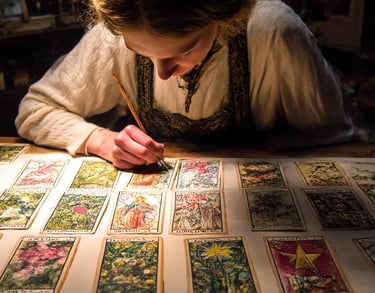
Tarot in the Modern Age
The 20th century saw tarot evolve from a niche occult practice into a mainstream cultural phenomenon. During the 1960s and 1970s, the rise of the New Age movement, combined with growing popular interest in spirituality, psychology, and alternative philosophy, brought tarot to entirely new audiences. The work of Swiss psychologist Carl Jung, whose theories of archetypes and the collective unconscious seemed to resonate deeply with the imagery of the Major Arcana, gave intellectual legitimacy to tarot as a tool for psychological introspection and self-exploration. Jungian tarot interpreters argued that the 22 Major Arcana cards represented universal psychological archetypes patterns of experience encoded in the human psyche and that working with them could illuminate the inner workings of the unconscious mind.

During this period, hundreds of new tarot decks were created, each reflecting the aesthetics, values, and concerns of its creators. Artists, spiritual seekers, feminist scholars, and cultural critics all found in the tarot a flexible and fertile medium for expression. Feminist decks reimagined the female figures of the tarot with greater power and agency. Decks inspired by non-Western traditions brought new cultural perspectives to the cards' imagery. The Thoth Tarot, designed by Aleister Crowley and painted by Lady Frieda Harris in the 1940s and published in 1969, offered a densely symbolic and intellectually challenging alternative to the Rider Waite Smith tradition, drawing on Thelemic philosophy, astrology, and Kabbalah in a radical new way.
By the 21st century, tarot had become a genuinely global phenomenon. Social media platforms like Instagram, TikTok, and YouTube gave rise to vast online communities of tarot practitioners, readers, and enthusiasts. Thousands of new decks are published every year, covering every imaginable aesthetic style from minimalist line drawings to lavish baroque paintings, from anime-inspired art to photographic decks, from decks themed around cats or crystals to scholarly recreations of historical designs. Tarot podcasts, online courses, apps, and subscription boxes have made the practice more accessible than ever before.
What is perhaps most striking about tarot's modern resurgence is the diversity of ways in which people engage with it. For some, tarot is a form of spiritual or religious practice, a means of communing with the divine or accessing higher wisdom. For others, it is a psychological tool a way of prompting reflection, clarifying thought, and exploring difficult emotions. For many, it is simply a creative and meditative practice, a way of slowing down, asking questions, and sitting with uncertainty in a fast paced world. The cards themselves do not change The Tower still depicts catastrophe, The Star still speaks of hope but the meaning people find in them is as varied and personal as human experience itself.
through a series of historical accidents, cultural shifts, and creative reimaginings one of the most recognized and enduring symbolic systems in the world. The cards have survived the printing press, the Enlightenment, the Industrial Revolution, two world wars, the rise of psychology, the digital revolution, and the social media age. Each time they have not merely survived, but flourished, finding new relevance and new interpreters in every era.
Whether you approach tarot as a spiritual practice, a psychological tool, an art form, or simply a fascinating cultural artifact, its history rewards careful study. It reminds us that the images and symbols we use to make sense of our lives are never fixed or static they evolve, accumulate meaning, and are constantly reshaped by the needs and imaginations of those who use them. In this sense, the history of tarot is not just the history of a deck of cards. It is a mirror held up to six centuries of human longing for wisdom, for connection, for self-understanding, and for a glimpse, however uncertain, of what lies ahead.
Whatsapp: +90 536 634 0818
Mail: baltaygun@gmail.com
© 2026 Taygun. All rights reserved.